Table of Contents
The Master of Intensity
When audiences think of Hollywood’s most memorable villains, Peter Greene inevitably comes to mind.
With his distinctive tall frame, deep voice, and pale complexion, Greene carved out a unique niche playing antagonists who were both terrifying and strangely captivating.
His career spanned over three decades, during which he delivered performances that continue to resonate with film enthusiasts and critics alike.
Peter Greene wasn’t just another actor playing bad guys; he was an artist who brought psychological depth and authenticity to every role.
From his breakthrough in the independent film Clean Shaven to his iconic turns in major Hollywood productions, Greene’s contribution to cinema remains significant and influential.

Early Life and Background
Birth and Family Origins
Peter Greene was born on October 8, 1965, in Montclair, New Jersey, as one of three siblings. Growing up in suburban New Jersey, Greene’s early life was marked by challenges that would later inform his powerful performances on screen.
A Turbulent Youth
Greene ran away from home at the age of 15 and experienced homelessness for several years. This difficult period in his life gave him firsthand experience with struggle and survival, elements that would later translate into the raw authenticity of his performances. These formative years shaped Greene’s understanding of human vulnerability and resilience, qualities that became hallmarks of his acting style.
Discovery of Acting
Unlike many actors who discover their passion in childhood, Peter Greene discovered acting in his mid-twenties while living in New York City. This late start didn’t hinder his career; instead, his life experiences enriched his craft, bringing a maturity and depth to his performances that younger actors often lack.
Acting Training and Method
Lee Strasberg’s Studio
Greene received his acting training at the prestigious Lee Strasberg Theatre & Film Institute in New York. The Lee Strasberg method, based on Konstantin Stanislavski’s system, emphasized emotional truth and psychological realism. This training proved perfect for Greene’s intense, naturalistic style.
The Method acting approach taught Greene to draw from his own emotional experiences, using “affective memory” to create authentic performances. His training focused on relaxation techniques, sensory exercises, and emotional preparation, tools that would become essential to his craft. The hardships of his youth provided a deep well of emotions to draw from, making his method of training particularly effective.
Development of His Craft
Through rigorous training and dedication, Peter Greene developed what would become his signature style: an ability to portray darkness and menace while revealing the humanity underneath. His tall, imposing physical presence combined with his deep voice created an unforgettable screen persona that directors would seek out for decades.
Career Beginnings
First Steps in Hollywood
Peter Greene made his screen acting debut in 1990 with an episode of the NBC crime drama series Hardball. This initial television appearance opened doors, but it was his transition to film that truly launched his career.
Laws of Gravity (1992)
Greene landed his first film role in the 1992 independent film Laws of Gravity, where he starred opposite Edie Falco. The gritty, realistic crime drama showcased Greene’s ability to portray authentic, street-level characters. His performance caught the attention of independent filmmakers who were looking for actors who could bring genuine intensity to their projects.
Breakthrough Performance: Clean, Shaven (1993)
A Career-Defining Role
Peter Greene’s breakthrough came with his starring role in Lodge Kerrigan’s 1993 psychological drama Clean, Shaven, where he portrayed Peter Winter, a man with schizophrenia suspected of murder. This challenging role required Greene to portray mental illness with unflinching honesty and sensitivity.
Critical Acclaim
The performance was nothing short of extraordinary. A New York Times review praised Greene’s work, noting he transformed the character “into a compellingly anguished, volatile character, someone who didn’t even have to slice himself up to get an audience’s attention”. Film critic Roger Ebert called Greene’s performance one of “great power and nerve.”
Festival Recognition
The film premiered at the Telluride Film Festival in September 1993 and was later screened at the Sundance Film Festival and Cannes Film Festival. Greene won Best Actor at the 1994 Taormina International Film Festival for his portrayal, establishing him as a serious dramatic actor capable of carrying a film on his shoulders.

Impact on Career
Clean, Shaven got Greene noticed by Quentin Tarantino, setting the stage for what would become one of his most famous roles. The film demonstrated Greene’s willingness to take on challenging, unconventional material and his ability to create deeply human characters even in the most difficult circumstances.
The Golden Year: 1994
Pulp Fiction
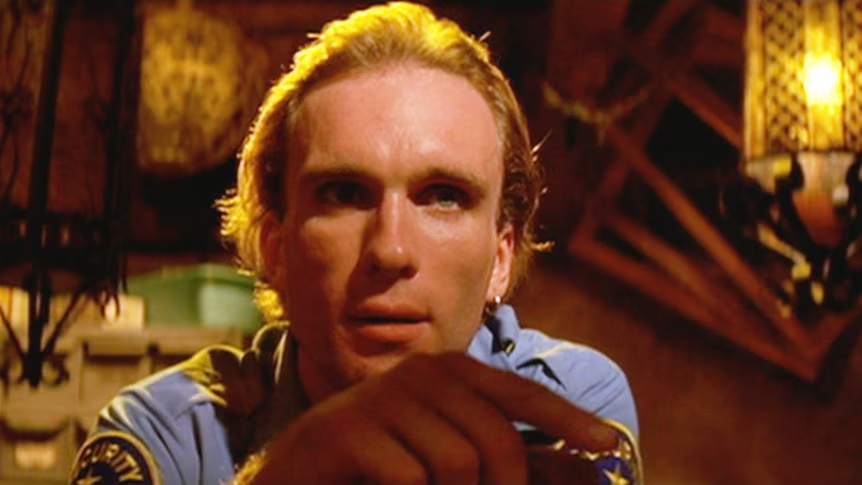
In 1994, Peter Greene appeared in what would become one of the most influential films of the decade. In Quentin Tarantino’s Pulp Fiction, Greene played Zed, a sadistic security guard. Though his screen time was limited, Greene’s performance left an indelible mark on audiences and critics alike.
The role required Greene to portray a character of extreme menace and cruelty, which he did with chilling effectiveness. His work in Pulp Fiction, which won the Palme d’Or at Cannes and became a cultural phenomenon, cemented his reputation as Hollywood’s go-to actor for intense, unsettling villains.
The Mask
The same year, Greene was cast as the main antagonist Dorian Tyrell opposite Jim Carrey in the superhero comedy The Mask. This role showcased Greene’s versatility, as he brought a theatrical, almost cartoonish quality to his villainy while still maintaining a genuine threat.
Working alongside Jim Carrey and Cameron Diaz, Greene held his own, creating a memorable antagonist for what became a box office hit. The film demonstrated that Greene could excel in both gritty independent cinema and mainstream Hollywood productions.
The Usual Suspects (1995)
In Bryan Singer’s neo-noir crime thriller The Usual Suspects, Greene played Redfoot, the fence who informs the crime crew about a jewelry heist opportunity. Though in a supporting role, Greene made it memorable with his intensity and street-smart presence.
During filming, Greene improvised a memorable moment by flicking a lit cigarette into Stephen Baldwin’s face, prompting screenwriter Christopher McQuarrie to call Greene “a million-dollar day player”. This anecdote illustrates Greene’s commitment to creating authentic, spontaneous moments on screen.

Establishing His Presence: Mid to Late 1990s
Continued Villain Roles
Following his breakthrough year, Peter Greene became one of Hollywood’s most sought-after character actors for villainous roles. His imposing presence and ability to project menace made him perfect for antagonist parts across various genres.
Judgment Night (1993)
In this thriller, Greene played one of the menacing pursuers, bringing his signature intensity to the role. The film showcased his ability to create tension and fear in audiences.
Under Siege 2: Dark Territory (1995)
Greene had a supporting role as a villain in the Steven Seagal action film Under Siege 2: Dark Territory. This marked his entry into big-budget action cinema, where his threatening presence proved valuable.
Kiss & Tell (1997)
Greene worked with director Jordan Alan on the film Kiss & Tell, showcasing his ability to handle dark comedy. This collaboration demonstrated Greene’s range beyond pure villainy.
Personal Struggles and Resilience
Battle with Addiction
Peter Greene’s career and personal life were significantly impacted by substance abuse. After arrests in 1998 for drug-related crimes, director Jordan Alan had to put Greene through rehabilitation to complete The Gentleman Bandit. The director eventually had to replace Greene’s voice due to vocal problems caused by drugs.
Greene’s battle with heroin was well documented in a several-page spread titled “Career High” in Premiere Magazine in 1998. This public struggle highlighted the dark side of Hollywood and the personal demons that many actors face.
Recovery Journey
Despite these setbacks, Greene demonstrated remarkable resilience. According to his manager Gregg Edwards, Greene had been sober for at least a couple of years before his death. His recovery allowed him to continue working and rebuilding his career in the 2000s and beyond.
Career Resurgence: 2000s and 2010s
Blue Streak (1999)
Greene appeared in the Martin Lawrence comedy Blue Streak, showing he could adapt his intense style to comedic contexts while still maintaining his edge.
Training Day (2001)
One of Greene’s most memorable later roles came in Antoine Fuqua’s Training Day. Greene played Jeff, a corrupt detective who agrees to be shot in his bullet-resistant vest to cover up a murder. His memorable line, “Kiss me, baby,” before being shot by Denzel Washington’s character, became iconic among fans of the film.
The role demonstrated Greene’s continued ability to create complex, morally compromised characters who were simultaneously repellent and fascinating.

Television Work
The Black Donnellys (2007)
Greene appeared in the short-lived NBC drama series The Black Donnellys, bringing his intensity to the small screen in a recurring role that showcased his range.
Justified (2010)
Greene appeared in the opening scene of the FX series Justified, setting the tone for the entire series with his menacing presence. A reviewer characterized him as a “thuggish Peter Weller lookalike,” and his scene with Timothy Olyphant established the show’s style and stakes.
Additional Television Appearances
Greene made guest appearances in Hawaii Five-0 (2010) and other television series, demonstrating his adaptability across different formats and genres.
Music Video Appearances
Greene appeared as a policeman in Prodigy of Mobb Deep’s music video for “A, B, C’s” and was the focal character in House of Pain’s video for “Fed Up”. These appearances showed his cultural reach beyond traditional cinema.
Later Career and Digital Media
The Jersey Connection (2018)
Greene delivered an emotionally-charged performance as Jordan Blaine in Tim Firtion’s crime drama web series The Jersey Connection. The role demonstrated that Greene remained committed to finding interesting, challenging work regardless of the medium.
The project garnered many awards on the festival circuit, with Greene receiving two wins and five nominations for his acting performance. This recognition proved that his talent hadn’t diminished with time.
Recent Television Work
Greene was featured in the 2020 TV series For Life, playing an Aryan Brother named “Wild Bill” Miller. Even in his later career, Greene continued to take on challenging, edgy characters.
He also appeared in a 2023 episode of The Continental, the John Wick prequel series, connecting with a new generation of action film fans.
Acting Style and Approach
Method Acting Influence
Peter Greene’s training at the Lee Strasberg studio fundamentally shaped his approach to acting. He employed method acting techniques, drawing from his own experiences, including his difficult youth and personal struggles, to create authentic, emotionally resonant performances.
Physical Presence
Greene’s physicality was a crucial element of his performances. His deep voice, tall stature, and pale complexion created an immediately recognizable screen presence that directors utilized to create tension and unease.
Psychological Depth
What set Peter Greene apart from other character actors was his commitment to finding the humanity in even the most villainous roles. Whether playing a sadistic guard, a mentally ill suspect, or a corrupt cop, Greene always suggested a complex inner life beneath the surface menace.
Versatility
While primarily known for villain roles, Greene demonstrated considerable range throughout his career. He could handle dark drama, action, comedy, and everything in between, always bringing his signature intensity and commitment to each role.

Theater Work
Beyond film and television, Greene’s theater credits included productions of Balls, Of Mice and Men, Back and Forth Again, Anna Christie, and Stories of Nam. His stage work kept him connected to his acting roots and allowed him to explore characters in the immediacy of live performance.
Professional Relationships and Reputation
Industry Respect
Greene’s manager Gregg Edwards called him “one of the best character actors on the planet”. This sentiment was echoed throughout the industry, where Greene was respected for his professionalism and dedication to his craft.
Edwards noted that “Nobody played a bad guy better than Peter,” while also emphasizing Greene’s gentler side and generous nature. This duality, the intimidating presence on screen and the kind person off screen, was a defining characteristic of Greene’s life.
Collaborations
Greene worked with some of cinema’s most respected directors and actors. From Quentin Tarantino to Antoine Fuqua, from Jim Carrey to Denzel Washington, Greene held his own alongside Hollywood’s elite while maintaining his unique character actor identity.
Personal Life and Character
Off-Screen Personality
Despite his menacing screen presence, Greene had “a gentle side that most people never saw, and a heart as big as gold,” according to his manager. Friends and colleagues remembered him as generous and kind, willing to help others despite his own struggles.
Intellectual Curiosity
According to Edwards, Greene tended to fall for conspiracy theories and held “interesting opinions”, suggesting an active, questioning mind that extended beyond his acting work.
Family
Greene is survived by a brother and a sister, both of whom were notified following his passing. Despite his tumultuous youth and career challenges, Greene maintained family connections throughout his life.
Final Projects and Legacy
Upcoming Work at Time of Death
At the time of his death, Greene had been cast in an upcoming Mickey Rourke film called Mascots, with production scheduled to begin in January. He was also involved in narrating a documentary titled “From the American People: The Withdrawal of USAID” with Jason Alexander and Kathleen Turner.

Edwards revealed that Greene “was passionate about shedding light on all the deaths that have happened around the world as a result of America dismantling USAID”, showing his engagement with social and political issues in his later years.
Death
Peter Greene died on Friday, December 12, 2025, at his home in New York City. He was 60 years old. He was found in his Lower East Side apartment on Clinton Street, where police responded to a 911 call about an unconscious male.
Edwards mentioned that music had been playing in Greene’s apartment for over 24 hours, which prompted a wellness check. No cause of death was immediately disclosed, and no foul play was suspected.
Impact and Influence
Character Acting Excellence
Peter Greene exemplified the art of character acting. He proved that supporting roles and villain parts could be as memorable and impactful as leading roles. His work inspired a generation of character actors who understood that every role, no matter how small, deserves complete commitment.
Representation of Mental Illness
Greene’s portrayal in Clean, Shaven remains one of cinema’s most sensitive and powerful depictions of schizophrenia. The film and his performance helped advance conversations about mental health representation in media, showing that such conditions could be portrayed with dignity and humanity.
Cultural Impact
From Pulp Fiction to The Mask, Greene appeared in films that became cultural touchstones. His characters, though often villains, became iconic in their own right, quoted and referenced in popular culture.
Method Acting Legacy
Greene’s commitment to method acting and emotional truth in performance contributed to the ongoing tradition of American naturalistic acting. His work demonstrated the power of drawing from personal experience to create authentic, moving performances.
Filmography Highlights
Major Films
- Laws of Gravity (1992) – Film debut
- Judgment Night (1993) – Thriller
- Clean, Shaven (1993) – Breakthrough starring role
- Pulp Fiction (1994) – Zed
- The Mask (1994) – Dorian Tyrell
- The Usual Suspects (1995) – Redfoot
- Under Siege 2: Dark Territory (1995) – Villain
- Kiss & Tell (1997) – Dark comedy
- Blue Streak (1999) – Comedy action
- Ticker (2000) – Action thriller
- Training Day (2001) – Jeff
- End Game (2006) – Action
- The Bounty Hunter (2010) – Crime thriller
Television
- Hardball (1990) – TV debut
- The Black Donnellys (2007) – Series regular
- Life on Mars (2009) – Recurring role
- Justified (2010) – Guest appearance
- Hawaii Five-O (2010) – Guest appearance
- Chicago P.D. – Recurring role
- For Life (2020) – Guest appearance
- The Continental (2023) – Guest appearance
Critical Assessment
Strengths as a Performer
Peter Greene’s greatest strength was his absolute commitment to authenticity. Whether playing a small supporting role or carrying an entire film, he brought the same level of intensity and preparation. His method training allowed him to access deep emotions and create fully realized characters, even when given limited screen time.
His physical presence was another asset. Greene understood how to use his body, voice, and face to create specific effects, menace, vulnerability, and unpredictability. He never relied on clichés or easy choices, instead finding unique ways to embody each character.
Range and Limitations
While Greene excelled at playing villains and troubled characters, he sometimes found himself typecast. However, he used this typecasting to his advantage, becoming the actor directors called when they needed someone who could bring depth and humanity to antagonist roles. Within this seeming limitation, he displayed remarkable range, making each villain distinct and memorable.
Contribution to Cinema
Peter Greene’s contribution to American cinema lies in his elevation of character acting to an art form. He proved that supporting actors could leave as lasting an impression as stars. His work in both independent and mainstream films bridged these often separate worlds, showing that artistic integrity and commercial success weren’t mutually exclusive.

The Peter Greene Legacy
Remembering an Artist
Peter Greene will be remembered as an actor who brought unwavering commitment to his craft. His performances in films like Clean, Shaven, Pulp Fiction, and Training Day remain powerful examples of screen acting at its finest. He showed that intensity didn’t require scenery-chewing, that menace could coexist with humanity, and that even the darkest characters deserved to be portrayed with truth and complexity.
Influence on Future Actors
Greene’s work continues to influence character actors who seek to bring depth and authenticity to supporting roles. His approach, combining method acting techniques with keen intelligence and physical presence, provides a template for actors who want to make every role count.
Cultural Resonance
The characters Peter Greene created have become part of film history. From his chilling turn as Zed to his theatrical villainy in The Mask, these performances continue to be discovered by new generations of film fans. His work in Clean, Shaven remains particularly relevant, offering one of cinema’s most honest portrayals of mental illness.
A Character Actor’s Character
Peter Greene’s life and career tell a story of talent, struggle, resilience, and artistry. From a troubled youth in New Jersey to training at Lee Strasberg’s prestigious studio, from homelessness to Hollywood, from addiction to recovery, Greene’s journey was as compelling as any character he played.
His commitment to his craft never wavered, even through personal difficulties. He brought the same intensity to a guest appearance on a television show as he did to a starring role in an acclaimed independent film. This dedication, combined with his natural talent and rigorous training, created a body of work that stands as a testament to the power of character acting.
Greene continued working until the end, with new projects lined up and a renewed sense of purpose. His passing at 60 came too soon, cutting short a career that was still producing compelling work.
Peter Greene leaves behind a legacy of memorable performances that will continue to move, frighten, and fascinate audiences for generations to come. He proved that character actors are the backbone of cinema, that supporting roles require as much skill and dedication as leading ones, and that authentic, emotionally honest performance never goes out of style.
In the pantheon of American character actors, Peter Greene has earned his place. His work reminds us that every performance matters, that truth in acting is paramount, and that even the darkest characters deserve to be portrayed with humanity and depth. That is the gift Peter Greene gave to cinema, and it is a gift that will endure.
FAQs
Who was Peter Greene?
Peter Greene was an acclaimed American character actor best known for his powerful portrayals of villains and complex characters in films like Pulp Fiction, The Mask, Clean Shaven, and Training Day. Born on October 8, 1965, in Montclair, New Jersey, Greene carved out a distinguished career spanning over three decades until his death on December 12, 2025, at age 60.
What was Peter Greene’s most famous role?
Greene’s most iconic role was Zed, the sadistic security guard in Quentin Tarantino’s 1994 masterpiece Pulp Fiction. However, he was also widely recognized for playing Dorian Tyrell, the main antagonist in The Mask opposite Jim Carrey, and for his critically acclaimed starring role as a man with schizophrenia in the independent film Clean Shaven.
What acting method did Peter Greene use?
Greene was trained in method acting at the prestigious Lee Strasberg Theatre & Film Institute in New York City. The Lee Strasberg method emphasizes emotional truth, psychological realism, and drawing from personal experiences to create authentic performances. Greene’s intense, naturalistic acting style was a direct result of this rigorous training.
Did Peter Greene always want to be an actor?
No, unlike many actors who discover their passion early, Greene didn’t pursue acting until his mid-twenties. After running away from home at 15 and experiencing homelessness, he discovered acting while living in New York City. His late start and life experiences actually enriched his performances, bringing depth and authenticity that younger actors often lack.
What was Peter Greene’s breakthrough film?
Greene’s breakthrough came with his starring role in Lodge Kerrigan’s 1993 psychological drama Clean Shaven. His portrayal of Peter Winter, a man with schizophrenia suspected of murder, earned him Best Actor at the 1994 Taormina International Film Festival and caught the attention of Quentin Tarantino, leading to his role in Pulp Fiction.
What challenges did Peter Greene face in his personal life?
Greene battled substance abuse, particularly heroin addiction, which significantly impacted his career in the late 1990s. His struggles were well-documented, including arrests in 1998 for drug-related crimes. However, Greene demonstrated remarkable resilience and had been sober for at least a couple of years before his death, according to his manager.
What made Peter Greene’s acting style unique?
Greene’s uniqueness lay in his ability to bring psychological depth and humanity to even the most villainous roles. His tall stature, deep voice, and pale complexion created an immediately recognizable screen presence, but it was his commitment to finding the emotional truth in each character that set him apart. He never relied on clichés, instead creating fully realized, complex characters.
Did Peter Greene only play villains?
While Greene became Hollywood’s go-to actor for villain roles, he demonstrated considerable versatility throughout his career. He appeared in dark dramas, action films, comedies, television series, theater productions, and even music videos. Each performance showcased his range and commitment to his craft, regardless of genre.
What was Peter Greene’s last project?
At the time of his death, Greene had been cast in an upcoming Mickey Rourke film called Mascots, with production scheduled to begin in January. He was also narrating a documentary about USAID with Jason Alexander and Kathleen Turner, a project he was passionate about due to its social and political significance.
How did Peter Greene die?
Peter Greene died on December 12, 2025, at his home in New York City’s Lower East Side at age 60. Police responded to a wellness check after music had been playing in his apartment for over 24 hours. No cause of death was immediately disclosed, and no foul play was suspected.
What awards did Peter Greene win?
Greene won Best Actor at the 1994 Taormina International Film Festival for his role in Clean Shaven. His performance in the web series The Jersey Connection (2018) garnered two wins and five nominations on the festival circuit. While he didn’t accumulate numerous awards, his performances were consistently praised by critics and respected by industry professionals.
Where did Peter Greene train as an actor?
Greene received his acting training at the Lee Strasberg Theatre & Film Institute in New York City. This prestigious school, founded by legendary acting teacher Lee Strasberg in 1969, is the only institution that teaches Strasberg’s method of acting technique in its complete and authentic form.
What films should I watch to appreciate Peter Greene’s talent?
To understand Greene’s range and talent, watch Clean Shaven (1993) for his raw, powerful dramatic work; Pulp Fiction (1994) for his unforgettable villain; The Mask (1994) for his theatrical antagonist in a mainstream comedy; The Usual Suspects (1995) for his memorable supporting role; and Training Day (2001) for his later career excellence. These films showcase different facets of his considerable talent.
Was Peter Greene involved in television work?
Yes, Greene appeared in numerous television shows throughout his career, including The Black Donnellys (2007), Justified (2010), Hawaii Five-O (2010), Chicago P.D., For Life (2020), and The Continental (2023). His television work demonstrated his adaptability across different formats while maintaining his signature intensity.
What was Peter Greene’s relationship with Quentin Tarantino?
Quentin Tarantino discovered Greene after seeing his performance in Clean Shaven and cast him as Zed in Pulp Fiction. This role became one of Greene’s most iconic performances and helped establish him as one of Hollywood’s premier character actors. Tarantino’s recognition of Greene’s talent was instrumental in elevating his career.
Did Peter Greene do any stage work?
Yes, Greene maintained connections to the theater throughout his career. His stage credits included productions of Ballads, Of Mice and Men, Back and Forth Again, Anna Christie, and Stories of Nam. Theater work kept him connected to his acting roots and allowed him to explore characters in the immediacy of live performance.
What was Peter Greene like off-screen?
Despite his menacing screen presence, Greene was known for having a gentle, generous nature off-screen. His manager, Gregg Edwards, described him as having “a heart as big as gold” and emphasized his kind personality. This duality between his intimidating on-screen characters and his gentle off-screen persona was a defining characteristic.
How is Peter Greene remembered in the film industry?
Greene is remembered as one of the best character actors of his generation, someone who elevated supporting roles to an art form. His manager called him “one of the best character actors on the planet,” and he was widely respected for his professionalism, dedication, and ability to bring depth to every role, no matter how small.
What legacy did Peter Greene leave behind?
Greene’s legacy lies in his elevation of character acting to an art form and his unflinching commitment to authenticity. He proved that supporting actors could leave as lasting an impression as stars, and his performances continue to influence character actors who seek to bring depth and truth to their roles. His work in films like Clean Shaven also helped advance conversations about mental health representation in media.
Are there any documentaries about Peter Greene?
While there isn’t a comprehensive documentary specifically about Peter Greene’s life, his struggles with addiction were documented in a detailed article titled “Career High” in Premiere Magazine in 1998. His career and contributions have been discussed in various retrospectives about 1990s cinema and character acting.
External Links and Resources
Official and Biographical Resources
- Peter Greene on IMDb – Complete filmography, biography, and career information
- Peter Greene Wikipedia Page – Comprehensive encyclopedia entry with career details and references
- Peter Greene on The Movie Database (TMDB) – Detailed filmography and profile
- Peter Greene on Rotten Tomatoes – Film reviews and ratings for his work
Training and Acting Method Resources
- Lee Strasberg Theatre & Film Institute Official Website – The school where Peter Greene trained in method acting
- Lee Strasberg Theatre & Film Institute at NYU – Information about the NYU partnership program
- Lee Strasberg Wikipedia – Biography of the founder of the method acting technique, Greene studied.
- Method Acting Explained – Understanding the technique that shaped Greene’s craft.
Notable Film Resources
- Pulp Fiction (1994) on IMDb – Greene’s most iconic film
- The Mask (1994) on IMDb – Greene as Dorian Tyrell
- Clean, Shaven (1993) Film Information – Greene’s breakthrough performance
- The Usual Suspects (1995) on IMDb – Greene as Redfoot
- Training Day (2001) on IMDb – Greene’s memorable later career role
News and Tributes
- Variety – Industry Coverage – Entertainment industry news and coverage
- The Hollywood Reporter – Film industry news and analysis
- ABC News Coverage – News coverage, including recent tributes to Greene
Related Character Actors and Industry Resources
- The Actors Studio – A Historic institution connected to the method acting tradition
- American Film Institute – Film preservation and education
- Screen Actors Guild (SAG-AFTRA) – Professional actors’ union
Film Industry Databases
- Turner Classic Movies (TCM) – Classic film information and preservation
- The Criterion Collection – Art house and classic cinema resources
- British Film Institute – International film resources and archives
Social Media and Community
- Lee Strasberg Institute Instagram – Current updates from Greene’s training institution
- IMDb User Reviews – Fan and critic reviews of Greene’s performances
Educational Resources
- Stanislavski’s System Information – The foundation of method acting
- Film School Resources – Contemporary acting education
- Acting Coach Resources – Industry resources for actors
Discover more from Sarkar
Subscribe to get the latest posts sent to your email.